Tuesday, April 30, 2013

Traveling the World Without a Passport


Students got to take a one hour trip to Africa today, during EvCC staff member Dennis Ryan's fascinating presentation on Zanzibar and Kilimanjaro in Tanzania, Africa.

The presentation was one of the weekly Tuesday Travelogues put on by the EvCC Humanities Center.

Ryan showed breathtaking photos of a wide variety of animals, including hyenas, flamingos, giraffes, zebras, water buffalo, and some great action shots of lions and lionesses on the hunt. He also showed pictures of the scenery from the trip and the native people. 

Ryan was in one of many groups of people going to climb Mount Kilimanjaro. Each group had what he called a “support group”: a small group of locals that carried the traveling group’s supplies, cooked for them, and acted as travel guides along the way in order to make money to support their families. But while the support group is meant to get people up and down the mountain, Ryan and two others in his group had to stop about 3,000 feet below the summit due to altitude sickness.
Dennis Ryan took students on a virtual trip to Tanzania
through his vivid pictures of people, animals, and scenery. 

After leaving Mount Kilimanjaro, Ryan and his group moved on to visit the small island of Zanzibar. Tour guides showed them old palaces and ones that were on the process of being restored. 

Ryan showed a photo of one of the buildings being restored, surrounded by makeshift scaffolding made of thin branches. He explained that due to their lack of funds and supplies, when there is enough money to restore a building, “you build scaffolding with whatever you can find”. 

Ryan and his group also traveled to the restored Last Palace of the Sultan, a spice plantation and a school in rural Zanzibar to donate school supplies to the children.


Tuesday Travelogues are held every Tuesday from 12:20 to 1:20 in various locations on campus. The presentations are free; come on in, sit down and take a trip across the world!


Story by Kelsey Salsgiver

Monday, April 29, 2013

The Clipper Music Blog: Track 3


Take a look at what the Clipper staff is listening to this week:

Megan Calbero, Editor in Chief: 
The Postal Service –"We Will Become Silhouettes"
http://www.youtube.com/watch?v=0rKC7ElkTUQ
"It's awesome and sometimes, you just need to listen to The Postal Service."

Liv Houseman, Assistant Editor:
Lupe Fiasco ft. Skylar Grey –"Words I Never Said"
http://www.youtube.com/watch?v=22l1sf5JZD0
"It's very political and blunt."

Kyle Millet, Web Editor: 
Matt Redman –"10,000 Reasons" (Bless the Lord)
http://www.youtube.com/watch?v=XtwIT8JjddM
"It's a good song. It's something– as a believer, something I should live by."

Jeff Hagglund, Photo Editor:
Sanctus Real –"Promises"
http://www.youtube.com/watch?v=sPO3meEuU24
"I've been listening to this for days because of what it means." 

Henry Yarsinske, Ad Manager:
Daft Punk ft. Pharrell Williams – "Get Lucky"
http://www.youtube.com/watch?v=5NV6Rdv1a3I
"In a world where dub step is popular dance music, daft punk is bringing it back to its roots." 

Christian Zerbel, Staff Writer: 
Nicki Minaj – "You a Stupid Hoe"
http://www.youtube.com/watch?v=T6j4f8cHBIM
"I can connect with the song at a cellular level. I really just get it. It's like she's speaking to me."

Kelsey Salsgiver, Staff Writer:
Macklemore and Ryan Lewis – "Can't Hold Us"
http://www.youtube.com/watch?v=2zNSgSzhBfM
"It's just really catchy."

Adnan Ali, Staff Writer:
Udit Narayan, Alka Yagnik – "Laal Dupatta"
"It's from a movie."

Sapphire Chan, Staff Writer:
Jayesslee – Cover of "Try" by Pink
"I think it's really cute how they do it."

Michael BublĂ© – "It's a Beautiful Day"
"It's a really happy song!"

Lily Haight, Staff Writer:
The xx – "VCR" 


Friday, April 26, 2013

Faculty Feature: Charles Fischer


Charles Fischer teaches English courses 98-103
as well as team teching Humanities 101
 with Joyce Walker and Jason Ripper. 


English instructor Charles Fischer has enthusiasm for literature. His passion becomes obvious when, as he discusses a text, he starts to talk faster and sits up in his chair, while leaning forward with thoughtfulness on his face.

He channels this enthusiasm into his teaching, so that his students can have their own intellectual experiences with literature.

“I try to communicate what’s interesting about my field, why it matters and why I love it,” said Fischer. “My job is to really show the students why the texts that I’m teaching are fabulous texts and why it’s important to learn how to think and write clearly about these texts. I’m trying to teach my students to read and think and write in an honest intelligent engagement with works of art.”

Fischer compares reading classic works of literature to drinking a good margarita or listening to Beethoven, or the Sex Pistols. Taste, he says, is subjective, and you must have your own experiences to be able to judge whether you think something is a classic or not. What matters is what brings pleasure into your life.

“Food and music and literature, for me, it’s the stuff that rewards. It gives pleasure,” said Fischer.

Not only does he find pleasure in literature, Fischer also enjoys meeting people and making connections with students.

“The other thing that’s great about teaching is the connection,” said Fischer. “It’s the opportunity for authentic human connection with your students and that’s kind of rare in life. It doesn’t always happen, but when it does happen, it’s great.”

"They say the only really way to know 

a text, or to know a book is to teach it...  

and when it goes well, it can be

 an ecstatic experience."


When he’s not teaching at EvCC, Fischer is at his home in Seattle, cooking and chatting with his wife or going for a run to prepare for the Cutthroat Classic, an 11-mile race in the North Cascades.

Fischer also recently finished writing a book, called “The Eunuch: Complete and Unexpurgated.” A work of ten years, Fischer explains that his novel is set in the 6th century B.C. during the time of Nebuchadnezzar II and is a “mock historical fiction” that is tragically comical. He finds that his taste in literature and art is surprisingly dark for someone with such a happy life, and that darkness shows through in his novel.

“I’m drawn to darker themes in art and literature. Human dysfunction, violence, illness, the underbelly of what it is to be alive, to be a human being. And I don’t know why, I’m a perfectly happy person and I have a really nice life. I have much in my life to be thankful for,” said Fischer.

Whether he’s listening to music, cooking, reading, or writing, Fischer finds happiness in his life with his wife Lisa and his dog Renzo.

“My wife Lisa is a fabulous conversationalist and really funny. Almost everything that comes out of her mouth is a delight,” said Fischer. “A lot of the joy in my life comes from being around my wife.”

Q&A:

Q: What’s your favorite TV show?

A: I’d have to say Breaking Bad and Archer. One’s a comedy cartoon; the other’s kind of a dark, American tragedy thing.

Q: What’s your favorite band or music group?

A: Well it kind of changes. Depends on what kind of genre and within the genre, I’ve got specific albums. Right now I listen to a lot of Miles Davis, “In a Silent Way.” There’s a song I can’t get out of my head right now called “Man in a Box” by Alice in Chains. They’re kind of like a Seattle old band, like a Nirvana, Pearl Jam type of thing. But I like everything, I like metal, I like jazz, rock, classical, Beethoven’s late string quartets, the song “Supernaut” by Black Sabbath. I also like Elton John a lot, early Elton John, Yellow Brick Road. I’m a music lover; I listen to everything. It’s an important part of my life. I’m a fan. I don’t play a musical instrument, can’t sing on key, and have no rhythm, but I like listening to music.

Q: What’s your favorite food?

A: I like to get a slice of New York pizza at a place called “Turnpike Pizza” on Greenlake in Seattle. It’s a good New York style pizza, the kind you fold over. There’s an Italian restaurant in Seattle I really like called “Tavolata.” I like Italian a lot. I make a mean lasagna. Japanese noodles, there’s a Japanese noddle place called “Udon Noodle” on the Ave in Seattle, so I’m doing kind of a Japanese Italian thing these days. Part of middle age is our gratifications become around the belly. The solace of middle age is food.

Q: If you could chose an instrument to play, what would it be?

A: Easy, electric guitar.

Q: If you could do anything in the world what would it be?

A: That’s the problem with teaching, is that once you do it there’s nothing else I would really rather do. I mean, I would’ve liked to be Keith Richards from the Rolling Stones. A rock star, but even that’s dated, there’s no rock stars anymore.

Q: Do you have a favorite book?

A: Well, I have a top twenty list… I would probably say “Lolita” by Nabokov and then “Blood Meridian” by McCarthy, and then probably “In Cold Blood” by Truman Capote. Those are three novels that I’ve taught a lot. They’re hard novels to read. They’re all about dysfunction and violence. The American violence….

Q: Do you have a favorite outdoor activity?

A: I like hiking in the mountains, I like down hill skiing, mountain biking. Anything in the mountains, really. I have a cabin in Methow Valley in the North Cascades and so whenever I’m out there I like to hike and mountain bike. And I like to ski locally.

Q: What’s your favorite class to teach?

A: I would have to say I like all of my classes equally, like children. I like the student body here at Everett, I’m energized by my students. I find them engaging and open and creative and smart. That’s the best thing about teaching is you meet a new batch of kids every quarter ad you make connections.

Q: What is one thing that you hope to do before you die?

A: Get my novel published.

A day in the life of Charles:

"Very dull, very routine. This is what I was talking about middle age; it’s just characterized by routine. I wake up about 6:30, and I have a cup of coffee, usually like a double espresso that I make out of my stove. A piece of peanut butter toast. I glance at the paper. You know, shower and shave, or not. I live in Seattle, so I get in my car and drive up. I try to get to my office early to do a little work. Teach my classes have my office hours, usually back in Seattle by late afternoon. I’ll go grocery shopping and plan the menu. I usually do all the shopping and cooking in the house. Maybe go for a run. My wife comes home, usually late from her day. She’s the managing editor at Seattle magazine. Then normally we’ll have a drink and debrief about our days. I make a really mean margarita. Cook dinner, maybe play some cribbage. If we have a television show that we’re currently addicted to we watch that, right now we don’t have anything going on. And then maybe do a little reading."


Charles Fischer will give a lecture for the Humanities Enlightenment Series on Enlightenment and Tragedy, May 21st from 10-11 a.m. in Whitehorse 105

Story by Lily Haight

Keep Calm and Drink Tea: Nippon Business Institute Offers Japanese Tea Ceremonies at EvCC


Imagine sitting quietly in a tea room, drinking tea as you listen to the natural sounds of water and wind blowing through leaves. Taking a deep breath, you begin to relax from a busy day while watching the Chanoyu, a Japanese tea ceremony.

Everett Community College's Nippon Business Institute (NBI) and together with the East-West Chanoyu Center held a Japanese Tea ceremony at NBI tea room for two afternoon sessions on Wednesday, a traditional culture of the Way of Tea by Japanese people.

The Japanese tea ceremony steps begin with cleaning and preparation of tea serving utensils (tea bowl, tea scoop and tea whisk), each step has concentrated and graceful movements (Pictures no. 1-3). Next step is added three scoops of green tea powder (3) then poured hot water into the bowl (4) and whisked into a thin paste (5). The last step, added more water as needed to create a soup-like tea.


“Tea ceremony is part of one of NBI programs, to introduce Japanese culture and this year, we have a tea specialist from Kyoto, Japan, her name is Tomoko Uchida.” said Mayumi N. Smith, Director NBI and Japanese Programs to Clipper reporter after the tea ceremony session yesterday.

Smith added that Uchida is a participant of NBI's Japanese Culture and Traditional Arts Internship Program. Uchida likes to learn American culture and get to know American people during her time in the US, and to introduce Japanese culture through the tea ceremony.
Mayumi N. Smith, Director NBI and Japanese Programs, sitting
together with Tomoko Uchida, a Tea Specialist from Kyoto, Japan,
in the tea room after the tea ceremony session on Wednesday afternoon.   
In this tea ceremony session, Smith mentioned that the reason NBI conducts this tea event in several days is because there are many students learning Japanese language and culture at EvCC.

“For today we have two sessions of tea ceremony; the participants were EvCC students and people from community. Previously, on the last week, we had the tea ceremony for EvCC Japanese clubs member and campus clubs, and last Saturday we had participants who study Japanese history and culture.”Smith said.

Smith said the NBI Japan study program is not just teaching Japanese language, but is also about teaching culture and history.

“I like to invite Japanese people as much as possible so that students and faculty staff have opportunity to know about the Japanese culture,” Smith said. “I hope that they can experience and feel the Japanese culture not only from watching it on TV or studying in class.”

Tea Ceremony


The tea ceremony is held in a tea room in the NBI. The interior is designed similar to the tea room in Japan.

“The tea room is not just the backdrop for tea ceremony, but also a tool by which participants journey to a separate world, the world of tea,” according to Makao Chiho, Niponica - Japanese culture magazine writer.

Uchida presented the four main principles: Wa Kei Sei Jaku,
which mean harmony, respect, purity and tranquility. 
Chiho said that by visiting a tearoom, guests leave behind their daily lives and enter a functional and aesthetic space designed to ensure that each cup of tea is not just drunk, but experienced.

The session beginning with Uchida introducing herself and the essence of the tea ceremony before she started the process.

“I study the tea ceremony process in high school and college, I began study seriously about tea ceremony was about five years ago,” Uchida said. “My own life based on the way of tea, the spirit of tea: harmony, respect, purity and tranquility.”

The essence of the Japanese tea ceremony is reflected in its four main principles: Wa Kei Sei Jaku (harmony, respect, purity and tranquillity).

Hannah Lovett, an EvCC student who attended the ceremony
recieved a bowl of tea after waiting for 20 minutes. She feels happy
when drinking the tastefull Japanese tea accompanied
by the Japanese sweets. 
She explained that those are the four principles of Chanoyu that formulated by the tea master Sen Rikyu (1522-1591). Harmony is the spirit of being harmonious with people and nature, Respect means to show respect to others, Purity means the state purity of the mind, and Tranquility means peace of mind and appreciation of nature's wealth.

She said that the demonstration tea ceremony today was the basic procedure of Chanoyu, the simplest one. She always recommends the guests to taste the Japanese sweets.

“Before drinking the tea it is necessary to eat the sweet Wagasi (Japanese sweets),” she said.

One of participants, Hannah Lovett, an EvCC student who studies Japanese culture and a tea lover, said that she enjoyed the tea ceremony from beginning till the end.

“The tea ceremony is interesting because we don’t have a lot of ceremonies in the United States, so it’s very different and I also love Kimono, it’s so beautiful,” Lovett said. “The tea process is like precise, almost like dance, you have to know what’s coming next. It’s very interesting,”

If you are interested in learning Japanese language and culture, or want to experience the tea ceremony, update yourself with the  EvCC Japanese club.

Arigato Gozaimasu!


Story by Ratna Wahyuningsih

Thursday, April 25, 2013

Drawing Your Life; a Recent YouTube Trend


If you are looking for ways to tell people about your life and don’t want to follow the dry convention of writing an autobiography, making a “Draw My Life” video might be an alternative for you.

“Draw My Life” videos have recently gone viral on YouTube and became a new trend on the site. For those of you who are YouTube geeks, you have probably noticed a lot of YouTubers have been posting their masterpieces of “Draw My Life” videos.

Just as much the same as the exploitable templateDraw Your Life, people describe how they have grown and changed throughout their lives by drawing stick figures. They also portray their childhoods or a particular aspect of life in theses videos, for example their careers and relationships matters.

YouTubers usually speed up the length of the drawing process during the videos. Although most of the “Draw My Life” videos are made up of simple stick figure drawings, YouTubers try to engage viewers’ attention by combining their artwork with entertaining and revealing anecdotes about their journey of becoming the popular sensations they are today on YouTube.

YouTuber Sam Pepper uploaded the first “Draw My Life” video on January 8, 2013. Until now, Pepper’s video has accumulated over 800,000 views.

In his five-minute video, Pepper drew on a whiteboard and narrated his life story starting from the time he was born to when he moved from England to Los Angeles in December 2012.

At the end of the video, he tagged fellow YouTubers Louis Cole and Caspar Lee to complete the task as well, in which both of them completed their “Draw My Life” videos in January 2013.

Check out the 10 best “Draw My Life” videos to know more about some popular YouTubers’ life stories and to see their “masterpiece” artwork. Some of them might be your favorite YouTubers!


Story by Sapphire Chan

Wednesday, April 24, 2013

Gardener Extraordinaire Ciscoe Morris Visits EvCC


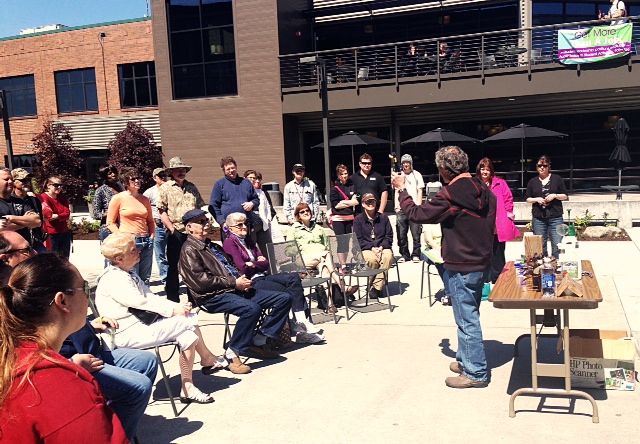
Ciscoe Morris, of “Gardening with Ciscoe” fame, visited EvCC today at 1:00 p.m. in the Gray Wolf plaza as a part of the celebration of Earth Week.

Morris brought excellent gardening advice to students and staff, with a focus on getting rid of garden pests in an environmentally friendly way. He encouraged using various strategies to deal with pests in your garden, including cultural pest control and mechanical pest control.
Ciscoe Morris, outside in the Gray Wolf plaza, explains
how to use environmentally friendly pest control techniques. 


“Cultural pest control means you grow the plants right in the first place,” said Morris. “Soil is the name of the game. If you’ve got great soil, you can do anything.”

Morris suggested ways to test soil to make sure it is good for planting, and suggested that if your soil isn’t good, you should build a berm of good soil to plant on top of.

“The other part about cultural care is, you wanna buy plants that are resistant to pests in our area,” said Morris.

If you buy plants, such as spot-resistant roses, that aren’t affected by pests, then you can avoid using harmful pesticides, suggested Morris. Predatory bugs can also be helpful to get rid of bugs that eat plants.

“Mama nature made the good bugs fast to catch the stupid bugs,” said Morris.

Students, staff, and community members came
to learn gardening techniques from Morris.


He then went on to explain different ways of mechanical pest control that aren’t harmful to the environment or poisonous to animals. One idea to get rid of slugs is to put a half inch to an inch of beer into a container with holes near the top of the lid. Slugs are attracted to the beer, but die when they drink too much.

“You’re asking slugs to stop at happy hour on the way to the restaurant,” exclaimed Morris. “Mechanical pest control is the most fun kind of control because it’s the ‘eek,’ ‘squish,’ and ‘kersplash’ kind.” 

Once the slugs have had too much to drink, Morris suggested pouring the slugs and leftover beer into the soil and burying it. Plant something there and it’ll grow like crazy, he said.

Morris followed up the gardening session with a time for question and answer. 

Participate in tomorrow’s Earth Day event, sustainable art competition judging in the White Horse hall critique space at 1 p.m.

Story by Lily Haight
 

Weekly Sports Roundup, Issue Three


Everett baseball continues its tear by sweeping a four game set against the Bellevue Bulldogs yesterday. The Trojans are ranked number one in the Northwest Athletic Association of Community Colleges and are in first place in the NWAACC standings.

Monday night’s game was about as dramatic as a game can get. In the bottom of the seventh and final inning, pinch-hitter Corbin Duffy singled home the winning run in a walk-off finish that was punctuated by Duffy receiving high fives and helmet pats as the Trojans swarmed the field.

Staff writer AJ Hansen took this video of the walk-off single, and yes, that is his guttural “YES” as the wining run crossed the plate. Inside of every grizzled sports writer, there is a fan. Usually our cheering is on the inside.


In Major League news, the Mariners are still horrible. The M’s are an abysmal 8-14 heading into today’s game. The only teams that are worse are the usual suspects: Padres, Cubs, Marlins, Astros and the Blue Jays.

In quirky sports news, New York has three teams, and a possible fourth in the playoffs in two different sports. The Knicks and the Nets are well into their NBA playoff run, and for the first time in seven years, the New York Islanders are in the NHL playoffs, with the New York Rangers trying to squeak into the Stanley Cup run as well.

As a transplanted New Yorker, this is awesome news for the city. As a Seattle fan, I have no idea how it feels to live in a city with three, let alone two, teams in the playoffs at the same time.

Story by Henry Yarsinske Jr.